An expressive line is a line an artist uses to help express emotions in a work of art. Look at the still-lifes above and below. Has the artist used expressive lines in either of these paintings? Why or why not? (You don't have to write anything down for these questions. Think about them and be prepared to discuss them in class on Tuesday.)
I found I could say things with color and shapes that I couldn't say any other way - things I had no words for. -Georgia O'Keeffe
Thursday, August 29, 2013
Friday, August 23, 2013
Contour Lines and Still-life
A still-life is an arrangement of objects an artist will use as the subject in a painting, drawing, print, etc. The objects do not move like a person or animal would. Look at the still-lifes below and answer the questions. You do not have to bring your answers to class but be prepared to talk about them!
Look at the still-life below. Where do you see contour lines? Which object is closest to you? How do you know?
Look at the still-life below. How is it different than the still-life above? Are there still contour lines?
Are these two paintings done by the same artist or different artists?
Be ready to talk about these in class!
Thursday, August 22, 2013
Introduction to Lines
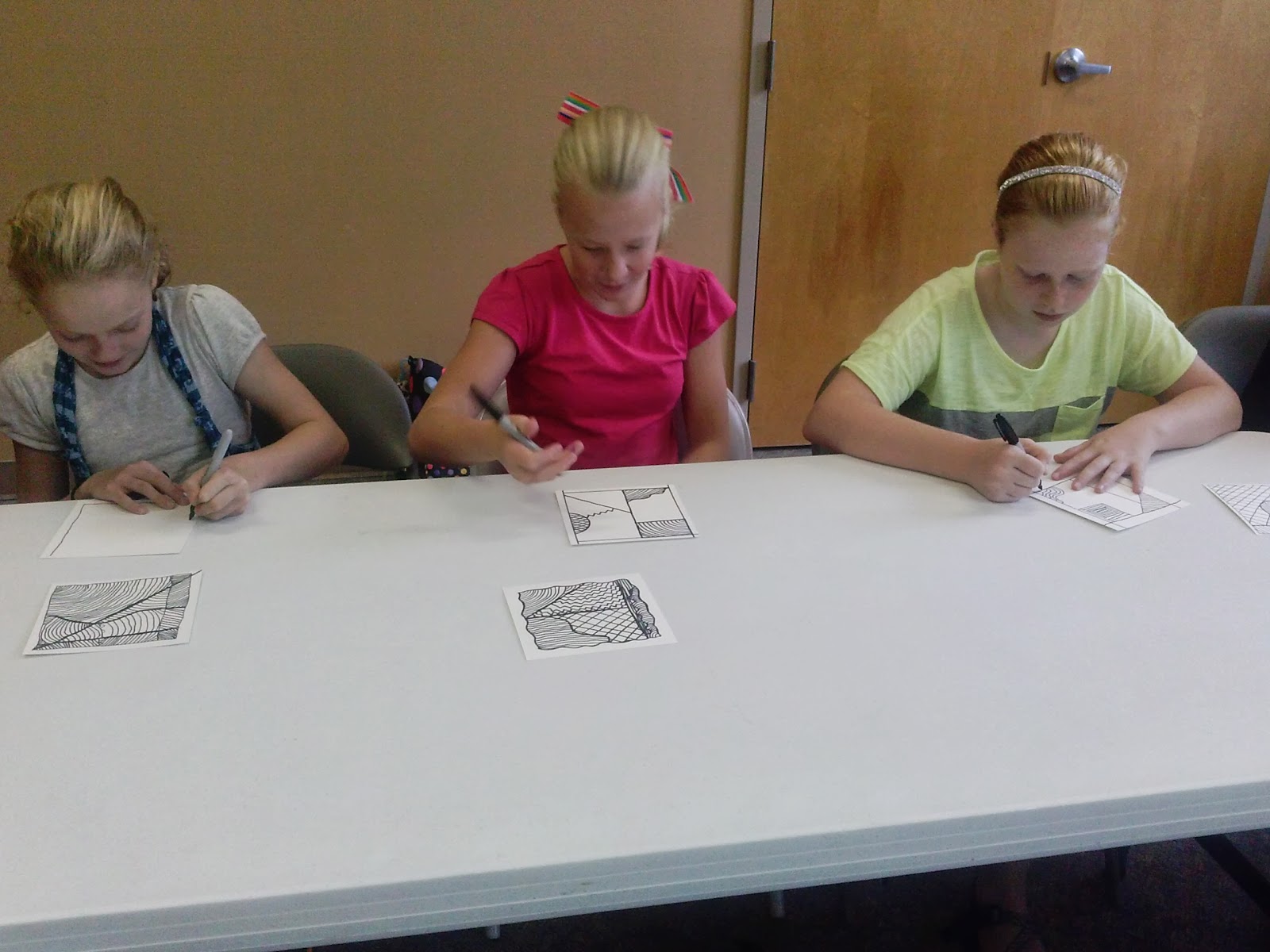
First day of class and we discussed our first element of design- line.
We created "Zentangles" using vertical, horizontal, diagonal, curved and wavy lines. These are unplanned designs that require students think about spacing, craftsmanship, and types of lines they are using to fill spaces. I enjoyed getting to know some of these kids better by seeing the way they draw and a small window into how they think. Good work!
Thursday, August 15, 2013
Welcome to a New Year!
Welcome to a new year with TEAM! I am very excited you will be in my art class this year and looking forward to seeing your work. This year we will be working on the Elements and Principles of design. What are the Elements and Principles of Design? I am glad you asked!...
Please watch this short YouTube video I put together....
http://www.youtube.com/watch?v=HiMmVGRkoH4
(Okay, I totally made this for a teaching class I took this summer but I am glad I can use it for our class too!)
Then, look at the work of art below. Using this image, please respond to my question in written form. Bring your responses to class. I am going to hold these until the end of the year. After exploring the elements and principles in class, we will answer this question again in May and compare our answers. I am looking forward to hearing what you have to say and please don't worry. The only way you can get this wrong is if you don't try!
The artist who painted this image, Piet Mondrian, is communicating to you. Based on what you see in the painting, what do you think he is talking about?
Saturday, December 8, 2012
Illusions
The painting above wowed and amazed the people of Renaissance Florence. It is a fresco (a painting completed on wet plaster) by the young artist Masaccio and is the first painting to use the newly discovered linear perspective. Many people saw this painting on the wall of a church in Florence and thought that it was an extension into another room. Masaccio used linear perspective and shadowing of light and dark on the figures to create his illusion of depth. Masaccio was such a talented artist that it is rumored that he was poisoned! The competitive art world of Florence, Italy may have been too jealous of his talent.
Our class worked on a scene that created the same illusion of a deep space. Using different values and complimentary colors, we added shadows to flat circles to make them appear to be round spheres.
We then drew checkerboards using linear perspective, painted the background black, and added stars to make the illusion of infinite space.
Finally, we arranged the spheres so the largest were the lowest on the page, also adding to the illusion of depth.
Ghirberti and Figure Drawing
Continuing our study of Renaissance artists, we looked at the life and work of Lorenzo Ghirberti. Ghirberti was a trained goldsmith who entered a contest to design a set of doors for the Baptistry at the cathedral in Florence, Italy. His design won and he spent years completing the doors.
When Michelangelo saw the completed set, he named them the "Gates of Paradise".

The panels on the doors show scenes from the Old Testament. However, the sculpted human figures are proportional, realistic, and Classically dressed. Ghiberti, like other Renaissance artists, merged the ideas of the Medieval period (Christianity) with Greek and Roman ideas (humanism and an emphasis on the human body).
We began our project by discussing the proportions of the human body.
Students also took turns posing for one another and doing figure drawing.
We took our drawings and created scenes using textures (rice, beans, pasta, dried glue) to build images using a human figure on foam board.
We covered the foam board with foil and carefully pressed the foil around the textures until you could see the image in the foil.
Finally, we covered our foil wrapped images with India ink and used steel wool to buff away the ink from the raised places on the image.
In the end, we got some pretty cool relief sculptures!
Tuesday, November 13, 2012
Giotto and Emotions
I finished my online course with an "A"- Hooray! To catch up, here are a few of the projects we have been working on in class.


Transitioning from the Medieval Period to the Renaissance, we talked about the artist Giotto. Giotto was discovered working as a shepherd in Italy. His drawings impressed a master artist who took him to Florence as his apprentice. There Giotto built a reputation as a painter and architect. His paintings moved away from the stiff, unrealistic human figures of the Medieval period. He added shadows and emotions to his figures making them feel more realistic and amazing the viewers of his time.
While working as an apprentice, Giotto learned, like other artists, to mix his own paint. Often paint was made from finely ground pigments and egg yolks.
We ground our own "pigments" using sidewalk chalk, rolling pins, and muscle.
We tried to make the chalk as fine as possible by crushing lumps between spoons.
We mixed the ground chalk with white glue (our egg yolk substitute) to make our own paint.
Thinking about the emotions Giotto used in his paintings, we also looked at Edvard Munch's The Scream.
Students chose an emotion (something other than "happy" or "sad"). Then, using the homemade paint, they created an image that communicated the emotion they chose. They did not have to use a realistic image in their painting but could choose to use simple lines and shapes to communicate their idea.
Can you tell which emotion each student chose?
Subscribe to:
Posts (Atom)