Sunday, September 15, 2013

Positive and Negative Shapes

Artists are sneaky.

Remember when we discussed implied lines?  These were lines that don't physically exist in a work of art but make your mind think or feel like they are there.

Artists use sneaky shapes too.

A shape is an enclosed line.  In your homework, you learned about geometric and organic shapes.

Geometric shapes have names like squares, circles, triangles, dodecahedrons, etc.

Geometric Shapes


Organic shapes don't have names and you usually see them in nature.
Organic Shapes


Artists also use Positive and Negative shapes.

Positive shapes are shapes that are filled by objects.  
Where are the positive shapes in the photograph below?


If you said inside the flower, you are correct!  The areas that are filled by the flowers, flower buds, and stems are positive shapes.
Positive Shapes


Negative shapes are usually empty spaces in a work of art.  

Where are the negative shapes in the photograph?

If you found the empty spaces between the flowers, flower buds, and stems then you are correct!
Negative Shapes

Look at the photograph below of the lily pads.  The negative shapes are the dark shapes of the water around the lily pads.  Imagine there were no dark shapes and lily pads filled the entire photograph.  Would it be as interesting?


Where are the positive and negative shapes in the photograph below?  Why did the photographer leave so much empty space around the three objects?


Wednesday, September 4, 2013

Implied Lines

Imagine your mom takes a look around your room and says, "Hey, would you like me to teach you to use the vacuum?" or "Would you like some new storage boxes?" or "Are you starting a dirty sock collection?" 

What is your mom really saying?

She is implying that you need to clean your room.  She is suggesting that your room is very dirty and you have too many socks on your floor.

To imply also means to suggest.  Therefore, an implied line is a suggested line.  It may not physically appear in a work of art but the artist has arranged objects, shapes, colors, etc in the work of art to suggest to your eye that a line is there.  Sometimes artists use these lines to direct your eye to move through a work of art in a particular way.

For example...

Look at the painting below called The Raft of the Medusa by Théodore Géricault.  The artist has arranged the objects in the painting to move your eye through the painting to a particular area.  Can you tell what he wants you to look at?


The Raft of the Medusa was painted by Gericault in the early 1800's after a French Naval boat called the Medusa shipwrecked and stranded 147 men on a makeshift raft in the ocean for thirteen days.  Only 15 men survived and the incident was a great political scandal.  

Do you see the implied line in the painting?  It is drawing your eye to the flag the man is desperately waving to get the attention of a far-off ship.  Look below.  Can you see it now?


Artists use implied lines to create movement, add meaning, and make their works of art more interesting.  

Where do you see implied lines in the design below?


Still-life Collage

We began our first project continuing to discuss line, the first element of design.  Students looked at how contour lines are found on the edges of objects and practiced drawing the contour lines of various vessels in their sketchbooks.  


We then began drawing contour lines of the same vessels on old book and atlas pages.  


We cut these drawings out and traced the pencil lines in sharpie to make the easier to see.


We then arranged these on a sheet of construction paper keeping in mind foreground, middle, and background.  

We also discussed Expressive Lines found in the still-lifes of Vincent Van Gogh.  Students used crayons to add color to the table area or negative space in the background.  They added expressive lines if they wanted (or had time) to these colored areas.  


 These girls are excited about Contour and Expressive lines!


Thursday, August 29, 2013

Expressive Lines?


An expressive line is a line an artist uses to help express emotions in a work of art.  Look at the still-lifes above and below.  Has the artist used expressive lines in either of these paintings?  Why or why not?  (You don't have to write anything down for these questions.  Think about them and be prepared to discuss them in class on Tuesday.)


Friday, August 23, 2013

Contour Lines and Still-life

A still-life is an arrangement of objects an artist will use as the subject in a painting, drawing, print, etc. The objects do not move like a person or animal would.  Look at the still-lifes below and answer the questions.  You do not have to bring your answers to class but be prepared to talk about them!

 Look at the still-life below.  Where do you see contour lines?  Which object is closest to you?  How do you know?


Look at the still-life below.  How is it different than the still-life above?  Are there still contour lines?


Are these two paintings done by the same artist or different artists?  

Be ready to talk about these in class!

Thursday, August 22, 2013

Introduction to Lines


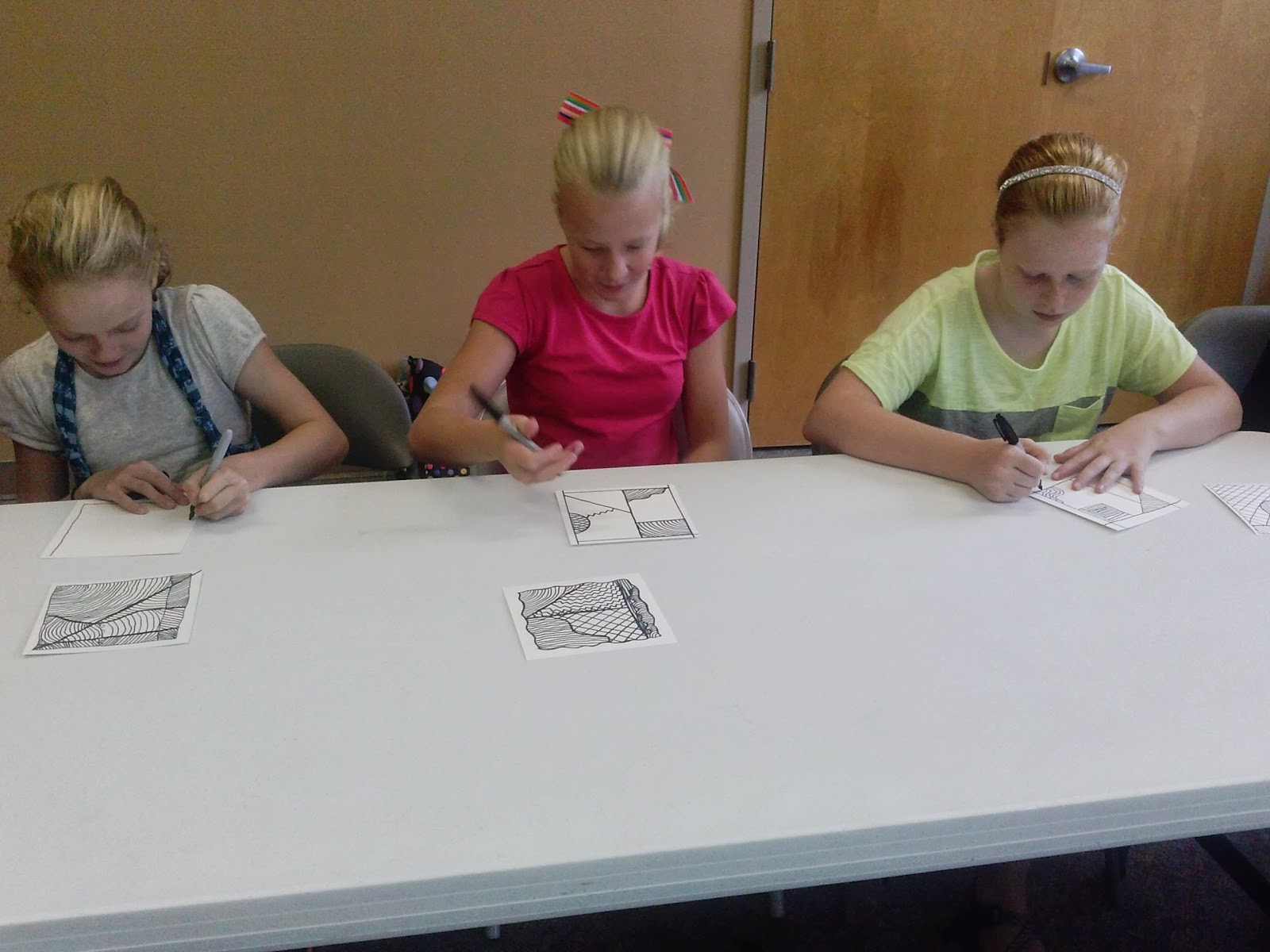
First day of class and we discussed our first element of design- line.


We created "Zentangles" using vertical, horizontal, diagonal, curved and wavy lines.  These are unplanned designs that require students think about spacing, craftsmanship, and types of lines they are using to fill spaces.  I enjoyed getting to know some of these kids better by seeing the way they draw and a small window into how they think.  Good work!


Thursday, August 15, 2013

Welcome to a New Year!

Welcome to a new year with TEAM!  I am very excited you will be in my art class this year and looking forward to seeing your work.  This year we will be working on the Elements and Principles of design.  What are the Elements and Principles of Design?  I am glad you asked!...

Please watch this short YouTube video I put together....

http://www.youtube.com/watch?v=HiMmVGRkoH4

(Okay, I totally made this for a teaching class I took this summer but I am glad I can use it for our class too!)

Then,  look at the work of art below.  Using this image, please respond to my question in written form. Bring your responses to class.   I am going to hold these until the end of the year.  After exploring the elements and principles in class, we will answer this question again in May and compare our answers.  I am looking forward to hearing what you have to say and please don't worry.  The only way you can get this wrong is if you don't try!

The artist who painted this image, Piet Mondrian, is communicating to you.  Based on what you see in the painting, what do you think he is talking about?